The automotive industry has never been more geographically complex.
- A regional sales manager covering a network of dealerships, service centers, and fleet accounts across three states.
- A field rep from an equipment manufacturer visiting dealer principals to review quarterly performance and drive adoption of new models.
- An aftersales coordinator managing warranty claims, parts delivery, and service technician dispatch across a wide territory.
- An account manager nurturing relationships with fleet procurement teams scattered across a metropolitan region.
Every one of these professionals has the same fundamental problem- their CRM knows a great deal about their accounts, but nothing about where those accounts are relative to where they are standing right now.
Proximity or Radius Search in Maplytics, the certified geo-analytical app for Microsoft Dynamics 365, Dataverse, Power Apps, and Power Pages, can change that. It can turn the geographic data sitting unused in every CRM record into an instant, actionable answer to the question every automotive field professional asks multiple times a day: “What else is nearby?”
| Key Takeaways-
1. The opportunity was never missing, it was just invisible in your Dynamics 365 CRM. 2. A cancelled appointment is a pipeline waiting to happen if your rep can see what’s nearby. 3. In aftersales, whoever gets there first wins. Proximity Search in Dynamics 365 makes sure that’s you. 4. One extra visit per rep per day compounds into real revenue without adding headcount. |
The Automotive Industry’s Invisible Opportunity Cost
The automotive dealer management system market was valued at USD 5.9 billion in 2025 and is projected to reach USD 13.1 billion by 2035, highlighting how aggressively the industry is investing in operational intelligence. Yet one of the most consistent and costly gaps in automotive field operations receives almost no attention- ‘the opportunity that goes unvisited because nobody knows it’s nearby’
Consider a typical day for a field rep covering a dealership network. They have four confirmed dealer visits scheduled. Between the second and third appointment, a cancellation opens a ninety-minute gap. The rep moves on to the next scheduled stop, even though, within a ten-minute drive, there is a fleet account that has been sitting untouched in the CRM for three months, a dealership that just missed its service penetration target and needs a conversation, and a prospect who expressed interest at the last regional show and has not been followed up.
 None of this information was hidden. It was all in Dynamics 365. It was simply invisible at the moment it would have been most useful.
This is the proximity gap, and in the automotive industry, where relationships win contracts, aftersales revenue depends on consistent touchpoints, and dealer performance is directly correlated with field rep visit frequency, it is a gap that costs real money every single week.
What Proximity Search Actually Does
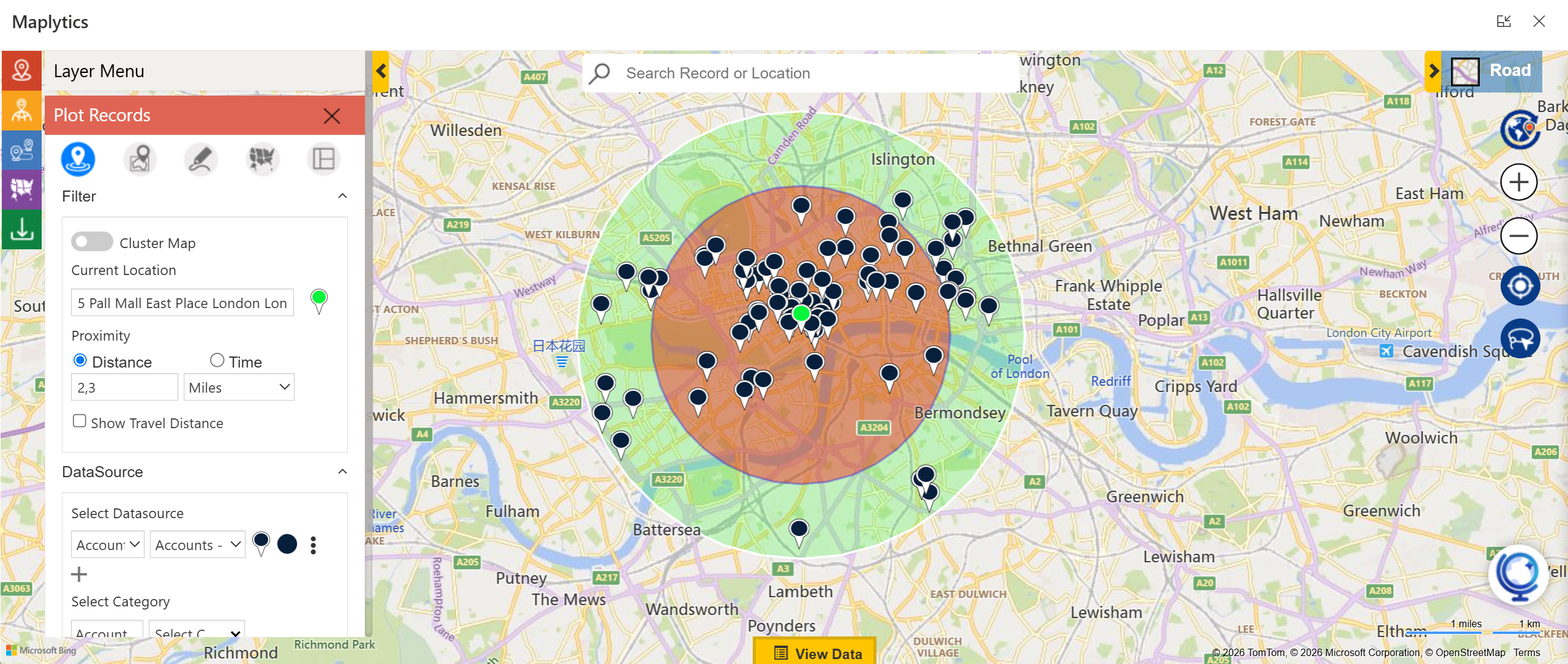
Maplytics’ Proximity Search or Radius Search allows field professionals to define a search area around any location, their current position, a dealer site, a service center, or any custom point, and instantly surface every relevant CRM record within that distance or travel time.
The results are not a static list. They appear as map pins inside the interactive Dynamics 365 map, filterable by entity type, account status, visit frequency, revenue, or any custom field stored in the CRM. A field rep can search for all dealerships within a thirty-minute drive that have not been visited in sixty days. An aftersales manager can find all fleet accounts within a ten-kilometer radius of a service center that have open warranty cases. An equipment manufacturer’s regional manager can surface every underperforming dealer within a day’s drive and plan a targeted intervention schedule.
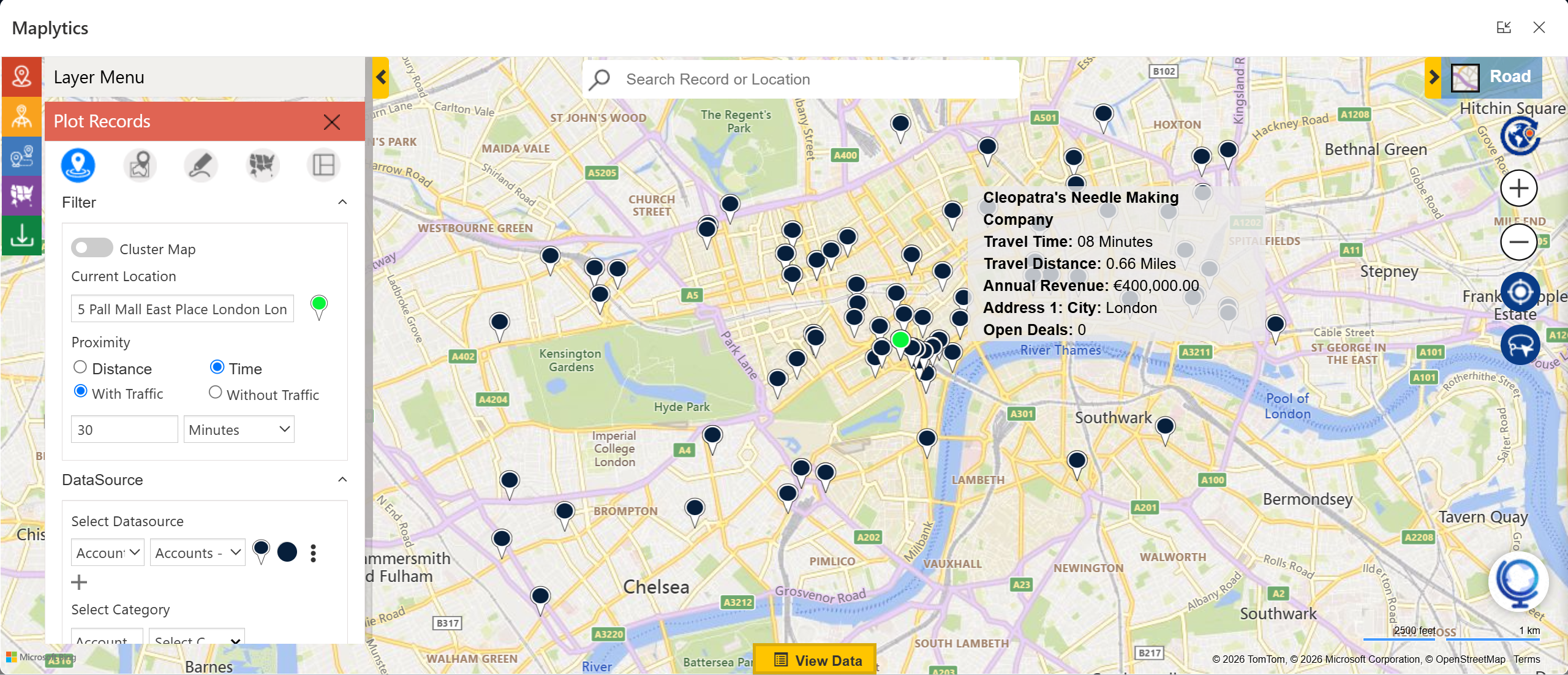 What used to require a phone call back to the office, a manual export, and a cross-reference with a separate mapping tool now takes a few taps on a mobile map, from the car park outside the previous appointment.
Use Cases Across the Automotive Value Chain
Dealer Network Management: Equipment Manufacturing field teams visiting dealer principals across wide territories can use Proximity Search to identify which dealerships are clustered geographically, building logical multi-stop visit sequences that maximize the number of dealer conversations per day. When a dealer meeting ends early or is cancelled, the nearest unvisited dealership, ranked by performance gap or strategic priority, surfaces immediately on the map.
Fleet Sales: Fleet account managers covering corporate, government, and rental customers across a region can use Proximity Search to find the nearest fleet prospects or lapsed accounts whenever a gap opens in the schedule. With 86% of buyers now researching online and visiting only two dealerships on average, the window for a timely, in-person fleet conversation is narrow. Proximity Search ensures that window is never missed simply because nobody knew the account was nearby.
Aftersales and Service Network Coordination: As aftersales revenue becomes an increasingly critical focus for dealer networks, particularly as EV growth slows and service plans, extended warranties, and vehicle health checks become primary revenue drivers, the ability to connect customers to the nearest service center quickly becomes a competitive differentiator. Proximity Search surfaces the nearest authorized service center or mobile technician for any customer location, routing urgent requests to the closest qualified resource rather than the next available one on a list.
Parts and Supply Chain Visits: Parts sales representatives visiting dealership parts departments and independent workshops can use Proximity Search to build territory coverage that leaves no viable account unvisited. Slow-moving parts accounts, lapsed workshop relationships, and new prospects in the same industrial area all surface when a rep searches their current location, turning every journey between confirmed stops into a potential new conversation.
EV Infrastructure and Charging Network Development: For automotive companies expanding electric vehicle charging infrastructure across dealer networks and public locations, Proximity Search identifies the nearest existing charging points, dealerships with EV-certified technicians, and fleet customers with EV transition plans, all relative to any proposed new installation point. Geographic planning that used to require a dedicated analyst can be done by a field manager in real time, on the map, inside Dynamics 365.
The Compounding Effect on Automotive Field Performance
One extra visit may seem small. But across 20 field reps, one additional meaningful interaction a day can quickly add up to stronger dealer relationships, better fleet retention, and increased aftersales opportunities.
No extra headcount, budget, or systems needed, just the ability to see relevant CRM data when your reps are closest to it.
The Bottom Line
The automotive industry is investing heavily in digital transformation. But better field performance needs more than faster workflows. It needs a live geographic view of existing opportunities.
Proximity Search in Maplytics makes that possible. The nearest dealer, lapsed account, or service customer was always in the CRM. Now your team can see them when it matters most.
FAQs
Here are a few interesting questions we get about Radius Search
What is Proximity Search in Dynamics 365 and how does Maplytics enable it?
Proximity Search in Dynamics 365 allows field teams to instantly surface CRM records, accounts, leads, contacts, or any custom entity, within a defined distance or travel time of any location. Maplytics brings this capability natively inside Dynamics 365, letting reps search from their current position, a client site, or any custom point on the map, and see results as filterable map pins in real time- no manual exports, no separate tools.
How does Radius Search in Dynamics 365 work with Maplytics?
Radius Search in Dynamics 365 through Maplytics lets field professionals draw a defined search area around any location and instantly see every relevant CRM record within that radius. Whether a sales rep is looking for nearby dealerships, a service coordinator is finding the closest technician, or a manager is identifying lapsed accounts within a specific region, Radius Search in Dynamics CRM turns a static list into a live, geographic view, filterable by account status, visit frequency, revenue, or any custom field.
What is the difference between Proximity Search and Radius Search in Dynamics CRM?
Proximity Search or Radius Search in Dynamics 365 surfaces nearby CRM records on a map; the key difference is how the search boundary is defined. Radius Search draws a fixed circular boundary around a location based on straight-line distance. Proximity Search goes further, allowing the boundary to be defined by actual travel time or driving distance, accounting for real roads, traffic, and route conditions. In Maplytics, both options are available inside Dynamics 365, giving field teams the flexibility to search by whichever geographic logic best fits their day.
What’s More?
If you are ready to bring automated planning to your organization’s Dynamics 365 environment, try Maplytics free for 15 days inside Dynamics 365. We would love to show you what a thinking map can do for your team. Maplytics with MapCopilot, its AI assistant, is available immediately for Dynamics 365, Power Apps, Power Pages, and Dataverse. Organizations interested in a personalized demo are also encouraged to contact Maplytics’ sales team at crm@inogic.com
For more information, visit our website or Microsoft Marketplace. One can hop onto the detailed Blogs, Client Testimonials, Success Stories, Industry Applications, and Video Library for quick query resolution. Technical docs for the working of Maplytics are also available for reference.
Kindly leave us a review or write about your experience on the Microsoft Marketplace or the G2 Website.

Sam Kumar
https://www.maplytics.comSam Kumar is the Vice President of Marketing at Inogic, a Microsoft Gold ISV Partner renowned for its innovative apps for Dynamics 365 CRM and Power Apps. With a rich history in Dynamics 365 and Power Platform development, Sam leads a team of certified CRM developers dedicated to pioneering cutting-edge technologies with Copilot and Azure AI the latest additions. Passionate about transforming the CRM industry, Sam’s insights and leadership drive Inogic’s mission to change the “Dynamics” of CRM.