

Confessions of a Sales Rep Who’s Been There
Hi, I’m Zack, a senior Sales Rep, and let me start with a confession.
I’ve driven 40 minutes for a meeting that got canceled.
I’ve visited two prospects five minutes apart… on different days.
I’ve lost deals not because the product wasn’t good, but because I was late, unprepared, or simply overwhelmed.
If you’ve ever been in sales, you know this truth.
Selling used to be about persuasion. Now it is about planning, prioritizing, and being in the right place at the right time.
If you can relate to Zack in any way, you would agree that today’s sales teams don’t fail because they lack effort. They fail because they lack clarity.
Studies show that sales reps spend nearly 65 percent of their time on non-selling activities like planning routes, updating CRM records, and figuring out who to visit next. At the same time, organizations using location-based insights or location analytics report up to 30 percent improvement in sales productivity.
So, what has changed over the years?
Sales strategy is not just about selling.
It’s about where, when, and how smartly you sell.
Here are five effective strategies that can transform how you work in the field. These are practical, boots-on-the-ground, grassroot-level strategies that real sales teams can apply immediately.

Strategy 1: Stop Assuming and Start Selling by Geography
Most sales teams say they have territories.
Very few actually use them well.
In the early days, a salesperson’s “territory” was basically a list of accounts and a vague understanding of regions in which to fall. That meant overlaps, missed opportunities, and plenty of “I thought you were handling that account” moments.
The moment we started visualizing territories on a map, everything changed.
Instead of reading rows in a CRM, with alphabets and figures, one could actually see
- Which accounts belonged to which salesperson
- Where his high-value prospects clustered
- Which areas were under-served
Territory Management turned abstract assignments into clear boundaries.
Application-
Your sales rep/manager could instantly tell which prospects fell within his region and which didn’t. No overlaps with teammates. No awkward internal calls. No wasted travel.
Balanced territories also mean fair workload distribution. Reps not burning out. Managers stop firefighting.
Geographic territory planning ensures
- Better account ownership
- Fair workload distribution
- Stronger regional focus
- Faster response times
Territory clarity alone can reduce internal friction by over 20 percent, according to sales operations benchmarks.
Experience Maplytics in your own environment!Download a 15-day free trial and explore location intelligence inside Dynamics 365.Download Free Trial
|
Strategy 2: Route Planning Is a Sales Skill, Not a Logistics Problem
Sales reps are not bad planners.
They are just given bad tools.
Before proper route planning, a salesperson’s day looked like this-
One meeting north. One south. One somewhere in between.
Great conversations. Terrible travel. Frequent delays and exhaustion.
When route planning becomes a part of the rep’s daily routine, his/her productivity exceeds.
Instead of manually checking maps, your salespeople could become empowered with-
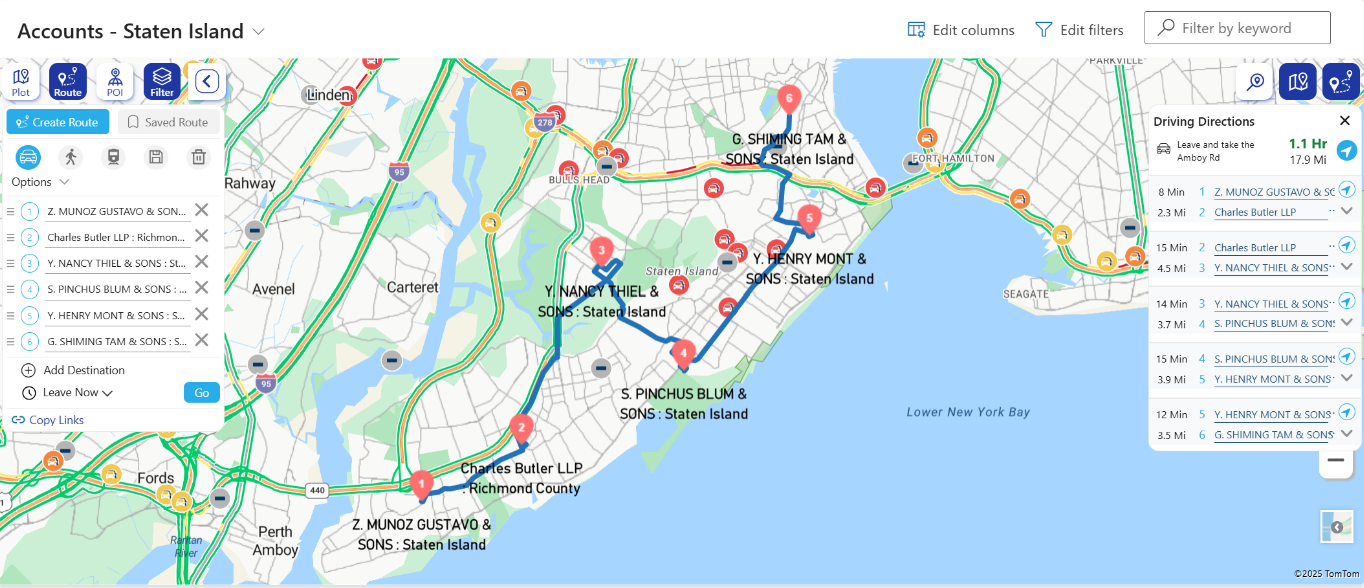
- Optimized multi-stop routes
- Avoid traffic-heavy areas
- Reduce backtracking
- Schedule more meetings per day
Application-
One afternoon, a field rep fit five client visits into what used to be a three-visit day, simply by planning routes intelligently and scheduling the right bunch of appointments together.
That’s not working harder, but smarter.
Optimized routing helps sales teams
- Save fuel and travel costs
- Increase daily visit capacity
- Reduce fatigue
- Improve punctuality
Companies using route optimization report up to a 25 percent reduction in travel time and 15 percent lower operational costs.
Strategy 3: Sell What’s Near You First
We often chase “important” leads that are far away while ignoring opportunities right next door.
Many members of Sales Teams used to search leads by industry, deal size, or stage. Location barely factored in.
That was a mistake.
Proximity-based selling changed everything.
Being able to search for leads, accounts, or opportunities around the salesperson’s current location meant
- Fewer wasted trips
- Faster follow-ups
- Higher meeting acceptance rates
- Effective utilization of time and energy
Application-
Between two meetings, a sales rep found three warm leads within a five-mile radius. He and his manager scheduled same-day visits and closed one deal within a week.
That wouldn’t have happened without location-aware selling.
Selling nearby helps teams
- Maximize time between meetings
- Increase face-to-face interactions
- Reduce no-show risks
- Improve relationship building
Sales teams that prioritize proximity often see higher conversion rates simply because they are more present, can accommodate ad hoc visits easily, and are responsive all the time.

Strategy 4: Let AI Handle the “What Should I Do Next” Question
Every sales rep asks this question at least five times a day.
“What should I do next, and how should I align the CRM for it?”
That mental load adds up.
This is where AI-powered assistants can change the game.
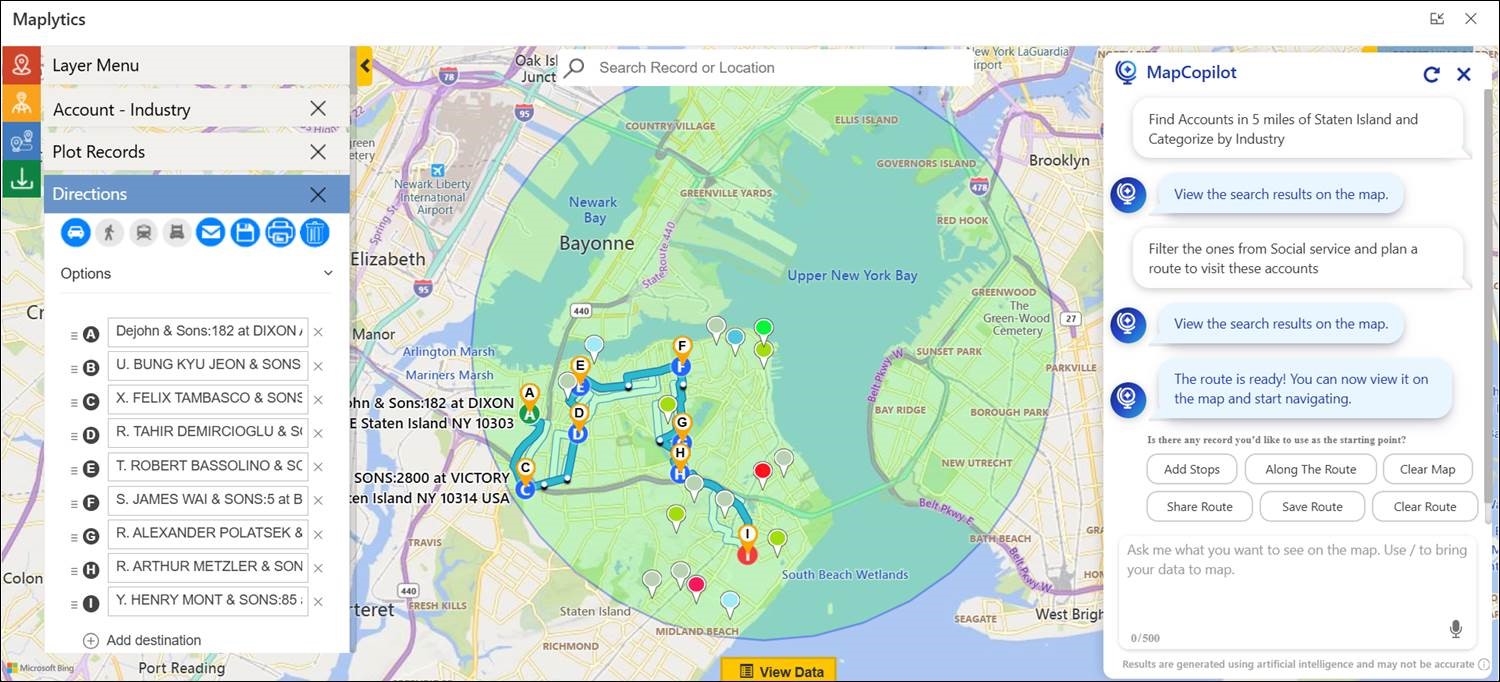
Instead of clicking through filters and dashboards, reps could simply ask
- Show nearby leads
- Plot my travel route for today’s customers
- Find accounts within 20 minutes of travel time
And the map responds instantly.
Application
While traveling, this salesperson asked for nearby prospects and optimized his route without stopping the car or opening multiple screens. He got a few results right along his travel route.
That’s not just convenient. That’s powerful.
AI-driven mapping assistants help sales teams
- Reduce manual planning
- Get instant insights
- Make faster decisions
- Stay focused on selling
- Increase the inclusivity of non-technical sales reps
AI-powered workflows can reduce planning time by 40 percent, freeing reps to do what they do best.
Strategy 5: Turn CRM Data Into Visual Stories
CRMs are full of data.
Sales reps are short on quick insights.
Tables don’t tell stories. But maps definitely do.
Seeing CRM data plotted geographically revealed patterns that sales teams never noticed before
- Strong clusters of closed deals
- Regions with long sales cycles
- Areas with high potential but low engagement
Application-
By analyzing deal density, heat maps, and territory performance visually, a sales rep could adjust their outreach strategy and re-prioritize regions that were being ignored.
That would lead to better pipeline balance and stronger forecasting.
Visual analytics helps teams
- Spot trends faster
- Identify gaps and opportunities
- Make data-driven decisions
- Improve forecasting accuracy
Organizations using visual sales analytics report up to 30 percent improvement in pipeline visibility.
Sales Strategy Is Now Location Strategy at its Root!
Modern sales success is about data and its effective context.
Optimized routing, territory management, proximity search, auto-scheduling, heat map analysis, AI-driven insights, and more are core sales capabilities.
Sales teams that adopt location intelligence sell smarter, faster, and with less stress.
Some common FAQs
1. How does territory management help sales teams?
It creates clear ownership, balances workloads, prevents overlap, and ensures every region gets the attention it deserves. The Territory Management feature offered by Maplytics allows auto territory creation, sales manager assignment, re-alignment of territories, drafting of efficient territories, and more.
2. Why is route planning important for sales reps?
It reduces travel time, increases daily visits, lowers fatigue, and helps reps focus more on selling than driving. With Maplytics, the users enjoy turn-by-turn navigation directions, auto rerouting, real-time tracking in the field, optimized travel routes avoiding tolls, highways, traffic, etc.
3. Can sales teams use AI for daily planning?
Yes. AI can help identify nearby prospects, suggest routes, and provide instant insights without manual effort. MapCopilot also helps with the same and more.
4. How does location intelligence improve sales performance?
It helps teams visualize data geographically, uncover hidden patterns, and prioritize high-potential areas.
5. Is this approach useful for inside sales teams too?
Absolutely. Even inside teams benefit from geographic insights for account planning, territory analysis, and regional strategies.
6. What a Salesperson Learned the Hard Way?
Sales will always be about relationships. But the way we manage time, territory, and travel has evolved. If your sales strategy still lives only in spreadsheets and lists, you’re missing half the picture.
The smartest sales teams don’t just ask.
“Who should I sell to?”
They ask
“Where should I be right now?” Or “Where is my client available?”
What’s More?
Maplytics is available immediately as part of the for Dynamics 365, Power Apps, Power Pages, and Dataverse. Organizations interested in adoption, 15-day free trials, or personalized demos are encouraged to contact Maplytics’ sales team at crm@inogic.com
For more information, visit our website or Microsoft Marketplace. One can hop onto the detailed Blogs, Client Testimonials, Success Stories, Industry Applications, and Video Library for a quick query resolution. Technical docs for the working of Maplytics are also available for reference.
Kindly leave us a review or write about your experience on the Marketplace or the G2 Website.

Sam Kumar
https://www.maplytics.com/Sam Kumar is the Vice President of Marketing at Inogic, a Microsoft Gold ISV Partner renowned for its innovative apps for Dynamics 365 CRM and Power Apps. With a rich history in Dynamics 365 and Power Platform development, Sam leads a team of certified CRM developers dedicated to pioneering cutting-edge technologies with Copilot and Azure AI the latest additions. Passionate about transforming the CRM industry, Sam’s insights and leadership drive Inogic’s mission to change the “Dynamics” of CRM.