
What is Route Planning?
Route planning is the process of deciding the best path to travel between one or multiple locations so you can reach your destinations efficiently while saving time, distance, and cost. It helps individuals and businesses choose routes based on factors like traffic, travel time, distance, priorities, and stop order, making journeys smoother, faster, and more productive.
Maplytics, with its Auto Scheduling and Optimized Routing, helps in efficient appointment planning and route management.
Why is Route Planning & Optimization important for businesses?
Route planning and optimization help businesses reduce travel time, fuel costs, and operational delays while improving on-time service and customer satisfaction. By planning efficient routes, teams can cover more locations in less time, avoid traffic congestion, and make better use of field resources. This is especially valuable for sales, delivery, and service teams that depend on daily travel. With location-based insights available directly alongside business data, teams can make faster and more informed routing decisions without switching tools. They can be ready with schedules in advance and also easily incorporate ad hoc changes.
How does Route Optimization work?
Route optimization works by analyzing multiple factors such as distance, travel time, traffic conditions, stop priorities, tolls, highways, and resource availability to calculate the most efficient path between multiple locations. Advanced solutions use real-time map data and intelligent algorithms to continuously refine routes as conditions change. When routing is connected to customer and operational records, users can generate optimized multi-stop routes, visualize them on a map, and adjust plans instantly based on real-world scenarios. Route Optimization in Maplytics ensures efficient field management, promotes work-life balance while increasing productivity and ROI.
What is the difference between route planning and route optimization?
Route Planning
Route planning is about creating a basic path from one location to another or across multiple stops. It focuses on where to go and usually considers simple factors like distance, order of stops, or directions. It’s often manual or semi-automatic and works well for straightforward trips.
Route Optimization
Route optimization goes a step further by finding the best possible route based on multiple variables such as travel time, traffic, safety of the routes, tolls and highways along the route, congestion frequency, priorities, delivery windows, vehicle capacity, and travel costs. It continuously adjusts routes to improve efficiency and productivity.
To sum up-
- Route planning decides the route.
- Route optimization perfects it to save time, money, and effort.
Applications like Maplytics empower users with both and are easy to use.
Can Route Planning software integrate with CRM systems?
Yes, modern route planning software can integrate with CRM systems to use customer addresses, appointment schedules, service requests, and sales data for smarter routing. This integration helps businesses plan routes directly from real-time CRM records, reduce manual data entry, and ensure field teams always work with the latest information. When route planning is connected to CRM data, teams gain better visibility, faster planning, and more accurate travel schedules.
Solutions like Maplytics enable this by allowing routes to be created and optimized directly from CRM records onto Azure Maps, ensuring location intelligence stays aligned with business data.

Can Route Planning integrate with CRM data and adapt to last-minute changes?
Absolutely. Advanced route planning tools can pull live CRM data and dynamically adjust routes when changes occur, such as canceled meetings/appointments, urgent service requests, or traffic delays. This flexibility allows businesses to respond quickly without redoing entire route plans, helping teams stay productive and meet customer expectations.
With Maplytics, routes can be recalculated using updated CRM records and location analytics, allowing field teams to adapt on the go while maintaining efficient travel plans. Your field reps can use Maplytics on mobile with the Dynamics 365 Mobile App and observe the rerouting in real-time with a few clicks.
Benefits of Routing and Optimization
Helps to save time and fuel
Routing reduces unnecessary detours by identifying the shortest or fastest paths between stops using distance, travel time, and traffic data. Efficient routing minimizes idle time, reduces fuel consumption, and helps teams complete more visits in a day. When routes are visualized alongside customer locations and schedules, businesses can plan smarter trips with fewer miles driven. Maplytics also provides users the ability to plot routes with turn-by-turn navigation directions to avoid getting lost on unknown roads and resultant backtracking. This saves time and fuel greatly.
Reduce travel costs
Routing reduces unnecessary detours by identifying the shortest or fastest paths between stops using distance, travel time, and traffic data. Efficient routing minimizes idle time, reduces fuel consumption, and helps teams complete more visits in a day. When routes are visualized alongside customer locations and schedules, businesses can plan smarter trips with fewer miles driven. Maplytics has helped one of its clients save $6000 per month and 16 hours per day with efficient, AI-driven routing and optimization.
What’s the best way to route multiple reps to different areas efficiently?
The most effective approach is territory-based routing, where each rep is assigned a defined geographic area, appointments are allotted within those regions, and routes are optimized within those boundaries. Visual territory maps, combined with automated scheduling and route suggestions, help distribute workloads evenly and avoid overlap between representatives. This also ensures that no client is left unattended.
Maplytics helps with Sales Territory creation and management, and these can be assigned with specific field reps and a territory manager.
How do traffic conditions affect route planning?
Traffic conditions directly impact travel time and delivery schedules. Real-time traffic data allows routes to adjust dynamically, helping teams avoid congestion, road closures, tolls, highways, or delays. This ensures more accurate arrival times and better schedule adherence. Maplytics users are empowered with this ability.
Improve customer satisfaction with Route planning
Absolutely. Faster travel times, predictable ETAs or arrival windows, and fewer missed appointments all contribute to better customer experiences. Route planning ensures timely visits and reliable service, which builds trust and long-term customer relationships. Accommodating ad hoc client requests quickly with fast reroutes also helps earn brownie points with the customers.
How can I use Google Maps/ Apple Maps/ Waze to plan a route in my area?
Google Maps/Apple Maps/Waze allow users to manually add stops, view traffic, and select alternate routes. While useful for basic navigation, businesses often need advanced tools that combine routing with customer data, scheduling, and performance tracking for daily operations. With Maplytics, users can plan optimized routes with turn-by-turn directions and then visualize them in Google Maps/ Apple Maps/ Waze App as required.
Can routes be planned based on customer locations and priorities?
Route performance can be analyzed by tracking key metrics, including distance traveled, time spent per route, fuel usage, and visit outcomes. Visual dashboards and historical route data help teams identify inefficiencies and improve future planning. Routes saved with Maplytics to particular client locations can be used again, rerouted, and utilized for all future uses.
How can route planning support same-day deliveries or visits?
Route planning enables same-day operations by quickly identifying customer locations, nearby field reps with the required skill, recalculating routes in real time, and fitting urgent stops into existing schedules. With location intelligence and live updates, teams can respond faster without disrupting planned routes.
How can I find the best optimized routes within a certain drive time?
You can find optimized routes within a specific drive time by using route planning tools like Maplytics that calculate travel time instead of just distance, factoring in road networks, traffic conditions, and multiple stops. This helps ensure visits stay within realistic time limits while covering the maximum number of locations efficiently.
Maplytics makes this easier by allowing users to plan routes based on drive time or distance directly on an interactive map, helping teams visualize coverage areas and choose the most efficient paths without guesswork.
Route Management for Field & Service Reps
What are the benefits of route planning for field teams?
Route planning helps field teams reduce travel time, lower fuel costs, and complete more visits per day. It improves scheduling accuracy, minimizes delays, and ensures better coverage of assigned areas. Maplytics enhances this by visualizing routes directly on interactive maps using live business data.
What are the best tools for route optimization in field services?
The best route optimization tools offer multi-stop routing, real-time updates, and map-based visualization. While options like Maptitude, Maptive, Badger Maps, and MapPoint exist, Maplytics stands out by combining route optimization with territory planning, auto-scheduling, CRM data, and a lot more on a single Azure/Bing map interface.
How can I optimize my sales/service routes for better efficiency?
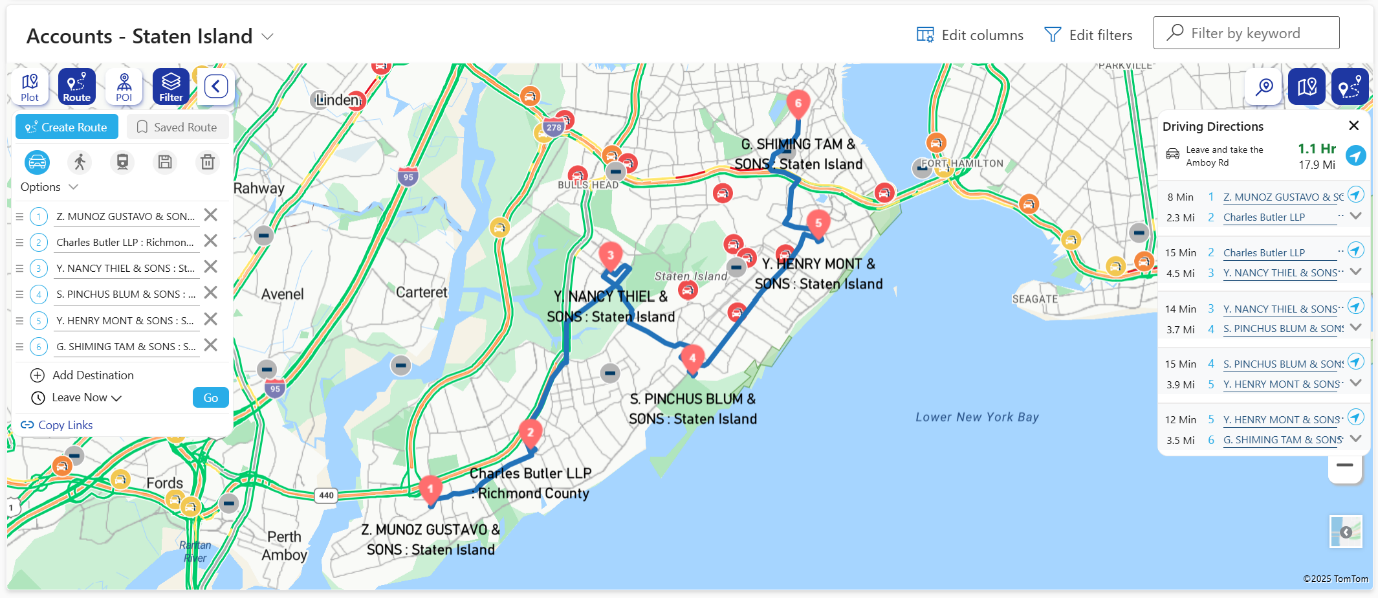
With the Maplytics license in place within Dynamics 365 CRM, you can plot the client locations in a particular sales territory on the Azure map. From those, you can select the client locations (multiple stops) you want the reps to visit on a day with a fixed Origin and Destination. Then, you can select if you want the most optimized route in terms of distance or time. Maplytics also offers you the option of avoiding traffic, tolls, and highways. Once selected appropriately, the most optimized routes can be visualized on maps with turn-by-turn travel directions. These can then be viewed on Google Maps/Apple Maps/ Waze as per the user’s convenience.
How do sales teams use route planning in daily operations?
Sales teams use route planning to organize daily visits, reduce travel fatigue, and ensure timely customer interactions. With tools like Maplytics, reps can quickly view nearby leads, plan routes, and adjust schedules while on the move. These plotted optimally planned routes can also be shared with clients via email, they can be saved for future use, or even printed out for convenience.
How does Route Planning help sales and service teams work more efficiently?
Route planning reduces unnecessary travel and improves time management, enabling teams to focus more on customer engagement than navigation. Integrated mapping solutions like Maplytics support this by combining routes, territories, and customer data in one place. If a planned meeting gets cancelled/ postponed, the users can find clients ‘Along the travel Route’ and arrange meetings with them as per availability.
How is Route Planning used in field service management?
In field service management, route planning helps assign technicians based on location, availability, skill, and service priority. Platforms like Maplytics allow managers to visualize technician territories and optimize routes for faster response times. The routes can be planned for days/weeks, months in advance. It can be done in the same manner within the logistics and delivery industry.
Can Route Planning support mobile sales teams?
Route planning ensures faster deliveries, optimized vehicle usage, and reduced operational costs. Map-based tools such as Maplytics help logistics teams plan efficient delivery routes while tracking progress in real time.
How does route planning help manage large sales territories?
Maplytics helps break large sales territories into manageable areas based on locations. These can then become helpful for optimizing visit sequences, reducing drive time, and ensuring better area coverage. When combined with territory mapping and proximity analysis, sales/service teams can focus on high-priority locations without overlap. Maplytics brings territory boundaries, routes, and CRM records together on a single map for easier planning.
Can you recommend user-friendly route apps for small businesses?
Several route planning and optimization apps are friendly for small businesses, such as:
Badger Maps, Salesforce Maps, GeoPointe, Portatour, MapPoint, etc. However, these tools lack deep CRM integration, analytics, and optimized planning out of the box. Maplytics stands out because it combines route optimization with powerful CRM data, letting businesses plan routes using real customer records, optimize multi-stop visits, factor in proximity filters, and visualize everything on an interactive map. Plus, Maplytics works directly inside your CRM interface and supports advanced features like automated pre-scheduled planning, radius searches, and AI-assisted prompts through MapCopilot. This gives small businesses both ease of use and strategic depth that basic route apps don’t provide.
How can AI improve route planning?
AI enhances route planning by analyzing traffic patterns, distances, priorities, and historical data to suggest smarter routes automatically. It reduces manual effort and helps teams respond faster to changes. AI-powered assistant, MapCopilot, within Maplytics simplifies this further by allowing users to plan routes using natural language commands.
How does real-time tracking enhance route planning?
Real-time tracking improves route planning by providing live visibility into rep locations, allowing quick rerouting when delays or changes occur due to processions, accidents, roadblocks, and other emergencies. It helps managers monitor progress and optimize schedules dynamically. When tracking is combined with mapping and CRM data, as in Maplytics, route decisions become more accurate and timelier.